|
| def | __init__ (self, states_df, score_type, max_num_mtries, tabu_len=10, ess=1.0, verbose=False, vtx_to_states=None) |
| |
| def | move_approved (self, move) |
| |
| def | finish_do_move (self, move) |
| |
| def | restart (self, mtry_num) |
| |
| def | __init__ (self, states_df, score_type, max_num_mtries, ess=1.0, verbose=False, vtx_to_states=None) |
| |
| def | climb (self) |
| |
| def | do_move (self, move, score_change, do_finish=True) |
| |
| def | refresh_nx_graph (self) |
| |
| def | would_create_cycle (self, move) |
| |
| def | move_approved (self, move) |
| |
| def | finish_do_move (self, move) |
| |
| def | restart (self, mtry_num) |
| |
| def | cache_this (self, move, score_change) |
| |
| def | empty_cache (self) |
| |
| def | __init__ (self, is_quantum, states_df, vtx_to_states=None) |
| |
| def | fill_bnet_with_parents (self, vtx_to_parents) |
| |
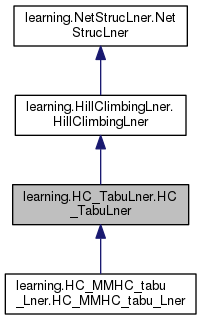
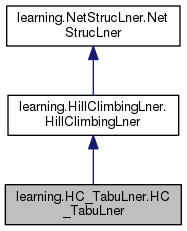
The class HC_TabuLner (Hill Climbing Tabu Learner) is a child of
HiilClimbingLner. It adds to the latter a Tabu list, which is a memory
of places that are forbidden to revisit, at least temporarily.

The idea is to keep a list of the last n moves. Then disallow any next
move that is in that list, BUT allow next moves that go downhill if no
uphill moves are currently possible and allowed. Each time a downhill
move is necessary, the starting point of that downhill move is a local
maximum. Of all local maxs encountered, the one with the highest score
is selected in the end.

Attributes
----------
is_quantum : bool
    True for quantum bnets amd False for classical bnets
bnet : BayesNet
    a BayesNet in which we store what is learned
states_df : pandas.DataFrame
    a Pandas DataFrame with training data. column = node and row =
    sample. Each row/sample gives the state of the col/node.
ord_nodes : list[DirectedNode]
    a list of DirectedNode's named and in the same order as the column
    labels of self.states_df.

max_num_mtries : int
    maximum number of move tries
nx_graph : networkx.DiGraph
    a networkx directed graph used to store arrows
score_type : str
    score type, either 'LL', 'BIC, 'AIC', 'BDEU' or 'K2'
scorer : NetStrucScorer
    object of NetStrucScorer class that keeps a running record of scores
verbose : bool
    True for this prints a running commentary to console
vertices : list[str]
    list of vertices (node names). Same as states_df.columns
vtx_to_parents : dict[str, list[str]]
    dictionary mapping each vertex to a list of its parents's names

tabu_list : list[tuple[str, str, str]]
    a list of the previous moves. The list's length is specified in the
    constructor by means of tabu_len parameter. Every time a new move is
    added to end of the tabu list, the first item of the list is removed.
best_loc_max_graph : networkx.DiGraph
best_loc_max_score : float
    Every time the restart() function is called because a try yields no
    moves with positive score change, we infer that a new local max has
    been reached. If total score of the current loc max is higher than
    best_loc_mac_score, we replace both best_loc_max_score and
    best_loc_max_graph by those of the better local max.
loc_max_ctr : int
    local maximum counter, counts the number of local maxs encountered.
| def learning.HC_TabuLner.HC_TabuLner.restart |
( |
|
self, |
|
|
|
mtry_num |
|
) |
| |
Takes in mtry_num, the number of the current move try, and returns (
restart_approved, mtry_num_fin) where mtry_num_fin equals the input
mtry_num. So this function does nothing to mtry_num, although it
could have. For example, in the class HC_RandomStartLner,
this function sets mtry_num to zero. Restarts are always approved
until they reach their limit given by max_num_mtries. Current
nx_graph and score is stored if its score is better than previous
best score.

Parameters
----------
mtry_num : int

Returns
-------
bool, int

 Public Member Functions inherited from learning.HillClimbingLner.HillClimbingLner
 1.8.11

